Niche modeling
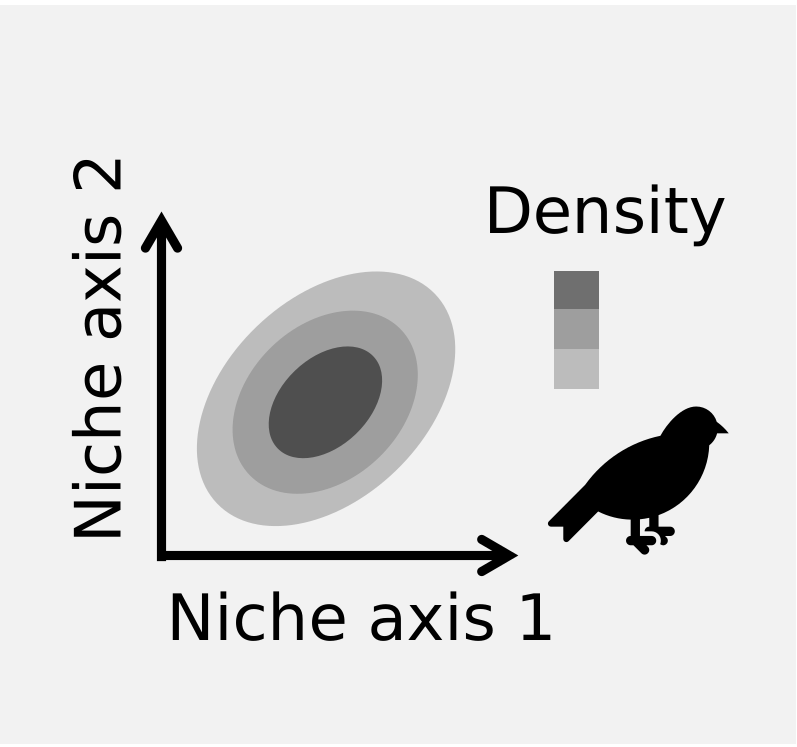
The concept of the niche (i.e. the environmental conditions that allow a species' persistence) is almost as old as the field of ecology itself.
Despite the normal unification and conceptual elegance of the idea, empirically measuring the niche is challenging.
I show how Hutchinson's hypervolume can be measured using
a probabilistic framework that allows partitioning niche variation into ecologically meaningful components.
The quantification of the environmental niche depends on the spatial grain over which it is measured. We develop
a conceptual framework to demonstrate how the scale-dependence of niche geometry can be predicted from key ecological attributes.
While understanding intraspecific niche variation is crucial for forecasting biodiversity change, the mathematical link between the species niche and individual niches remains elusive. I show how to
scale from individual niches to the species niche, opening up new opportunities to investigate ecological and evolutionary topics.

The theory of island biogeography (TIB) proposed by R. MacArthur and E.O. Wilson in the 1960s is one of the cornerstones of modern ecology. Yet, a key element of community ecology—beta diversity patterns (variation in community composition)—is missing from their theory. I derive
beta diversity patterns from the TIB and show how they are linked to extinction, colonization, and the size of the species pool. Combining the TIB and the meta-population model, I further demonstrate that meta-community dynamics could lead to
complex response of beta diversity to dispersal.
Traditional beta diversity metrics do not account for species associations, which could lead to biased inference of community assembly. We took
a geometric approach to measure beta diversity and show how it offers a more holistic view of metacommunity dynamics.
Extinction risk

Climate change poses a severe threat to thousands of species. Predicting species' extinction risk is critical to guiding biodiversity conservation efforts. Using
a novel climate change vulnerability measure, we show that coarse-grain analysis can seriously underestimate the extinction risk of tropical species.
We further investigate how the
timings of extreme climate exposure are shaped by species' distribution and ecological traits.